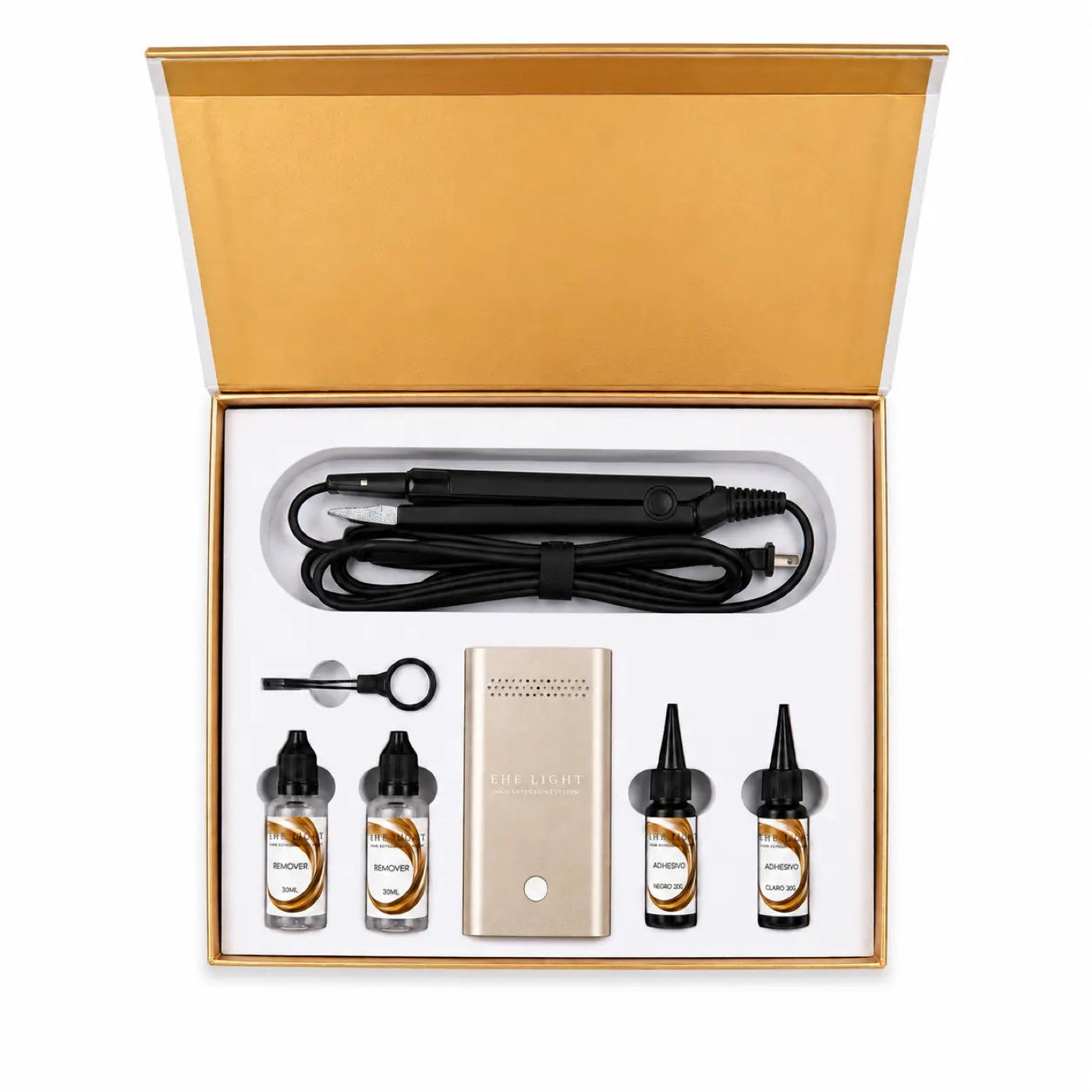
The short answer on price: the cost of applying UV hair extensions depends on three main factors: the amount of hair applied, the quality of that hair and the time spent in the salon. Every salon sets its own prices, so we do not publish a price list, and the safest approach is to ask for a detailed quote. Maintenance is usually every 6 to 8 weeks, as a guide.
“How much will it cost?” is the first question almost every client asks, and rightly so. The problem is that when you search for hair extension prices, you find figures that are miles apart, with no explanation of what each one includes. Let’s put some order into it.
What the price covers, by method
| Method | What makes the price vary | What the price usually includes |
|---|---|---|
| UV extensions, application only | Number of bonds and application time | Consultation, application and aftercare advice. The hair is supplied by the client |
| UV extensions with hair supplied | Hair quality and quantity, length | Remy hair, application plan, cutting and blending, check-up |
| Tape-in extensions | Number of tapes and hair quality | Hair tapes and application |
| Nano rings and micro rings | Number of rings and hair quality | Hair and application |
| Keratin | Number of strands and application time | Keratin strands and application with a heated clamp |
A qualitative table, with no figures: every salon sets its own prices.
What pushes the price up or down
1. The hair
By far the heaviest cost. Real Remy hair, with the cuticles all running in the same direction, tangles less, lasts through several maintenance appointments and can be coloured. Cheap hair tends to matt within a few weeks. As a reference point, in the EHE LIGHT™ shop you can find 100 g of sewn-in Remy hair extensions.


2. The quantity
Adding a little volume is a world away from going from mid-length to waist-length hair. As a guide: 80 to 120 bonds for volume on fine or medium hair, 120 to 200 for a complete change, and over 200 for a lot of length or density.
3. The salon and its location
Prices vary from one salon to another depending on the town or city, the positioning and the specialisation. A salon that specialises in extensions will often charge differently from a general salon or a mobile service. We do not quote figures.
4. The experience of the person applying
A professional trained in the method works faster, spreads the weight better and carries out clean removals. That has a price, and it matters.
Comparing salons: the right questions
- Which system do they use? The device, adhesive and removal solution should be designed to work together.
- Where does the hair come from? Ask about the quality (Remy or not) and the length on offer.
- How is removal done? A clear removal protocol is a good sign.
- What does the quote include? Hair, application, cutting, check-up and maintenance appointments.
Always ask for a detailed quote. If the answer about the system used stays vague, keep looking.
The real cost over a year
The price of the first appointment is only part of the budget. What really matters is what it costs to wear extensions for twelve months.
| Cost item | UV extensions (cost structure) |
|---|---|
| First application with Remy hair | The biggest item of the year |
| Maintenance (every 6 to 8 weeks, so around 6 a year) | Depends on the number of bonds |
| Replacing the hair | Depends on wear, often once a year |
| Home care products | Gentle shampoo and a suitable brush |
An illustrative example of structure, not a price. Always ask your salon for a firm quote.
Because Remy hair can be reused, and removal and reapplication happen in the same appointment, the monthly cost is often lower than the first bill suggests.
What about the cheap UV kits sold online?
They exist, and for very little money you get a lamp and a bottle of adhesive. But these kits do not always include a removal solution suited to that adhesive, or a protocol for using it. What you save on the kit can be paid for on the hair. EHE LIGHT™ is the brand of this system; consumables and instructions from other brands are not interchangeable. To understand why the technique matters so much, read UV or keratin extensions: how do the application methods differ?

If you run a salon: how to set your prices
For a salon, the complete EHE LIGHT™ professional kit includes the device, the adhesives, the removal solution, the tools, the Professional Guide (digital manual) and 6 months of support. We do not recommend a price list: work out your price from your application time, the cost of the hair and your overheads. We go into these points in offering UV hair extension application in your hair salon.
The EHE LIGHT™ system for professionals: the complete kit. Delivery rates are shown at checkout.
View the kitFrequently asked questions about price
How much do UV light natural hair extensions cost?
It depends on the salon and on the quantity and quality of the hair. Every salon sets its own prices, so ask for a detailed quote that states what is included.
How much does UV extension maintenance cost?
It depends on the salon and the number of strands. It is usually done every 6 to 8 weeks and involves removing, cleaning and reapplying the same hair in the same appointment.
Are UV extensions more expensive than keratin?
Not necessarily. The price depends above all on the hair, the quantity and the application time, whichever method is used.
Why are some extensions so cheap?
Most often because of the type of hair (non-Remy or synthetic), or because they are applied with equipment of unknown origin and without a removal protocol.