In short: UV light hair extensions are attached with a clear UV adhesive that cures under 395 nm ultraviolet light in 6 to 8 seconds per side. Application is cold, with no heated tool, and the bond is discreet. Once the adhesive has cured it is water resistant (ideally keep it dry for the first three days) and it lasts up to 2 months before maintenance.
If you have scrolled through Instagram or TikTok lately, you have probably come across a video of a hairdresser lighting up a section of hair with a small purple light. Those are UV light hair extensions. The technique is attracting more and more clients who want length without exposing their hair to heat.
Here is a clear explanation, with the real technical data and the questions we are asked most often in the salon.
What are UV light hair extensions?
They are natural human hair extensions attached to your own hair section by section, just like keratin extensions, with one important difference: instead of melting a small keratin tip with a heated tool, a drop of liquid adhesive is placed on the bond and cured under ultraviolet light.
The idea comes from the nail and dental worlds. It is the same principle used to harden a gel nail polish or a dental composite: a photo-initiator in the resin reacts to light and turns the liquid into a solid, flexible, clear material within seconds.
For EHE LIGHT™ UV technology, the device works at 395 nm, in the long-wavelength UV-A band.

How the application works, step by step
A full application is not mysterious, but it does take technique. Here is how it goes in a salon working with the EHE LIGHT™ system:
- Consultation and hair selection. We look at the density, shade and texture of the client’s hair to choose the Remy hair that blends best with their own.
- Wash without conditioner. The hair must be clean and completely dry, with no oil or silicone at the root.
- Sectioning. We work in fine sections, placing each bond 1 to 1.5 cm from the scalp so that it does not touch the skin and cannot be seen.
- One drop of adhesive. The extension strand is joined to a section of the client’s own hair of the same thickness with one drop of UV adhesive, clear or black depending on the hair colour.
- Curing under the light. The bond is lit for 6 to 8 seconds on top, then 6 to 8 seconds underneath, always within 1 cm.
- Cutting and blending. To finish, we cut and style so that you cannot tell where the client’s hair ends and the extension begins.

There is no waiting for keratin to cool and no going back over each bond with a heated tool, so a full head can be done in under 2 hours, whereas traditional methods normally take 3 to 4 hours.
How long do UV hair extensions last?
The bond lasts up to 2 months. Clients usually return to the salon every 6 to 8 weeks for maintenance: the strands are removed, the root is cleaned and the strands are re-applied in the same appointment. If the hair is well washed and thoroughly dry, there is no need for a rest period between applications.
The extension hair lasts much longer. Good Remy hair, well cared for, can be reused across several maintenance appointments, which lowers the cost in the long run. We go through the cost factors in our article on what makes the price of UV extensions vary.
What shortens the life of the bonds most:
- Oils and masks applied directly to the root.
- Sleeping with wet or loose hair.
- Brushing from the top and pulling on the bonds.
- Bonds carrying too much hair for the section that supports them.
Can you get them wet? Can you go to the beach?
Yes, with a few precautions. This is one of the most frequent questions, especially in summer. Once the adhesive has fully cured, the bond is water resistant, but it is best to avoid getting it wet for the first three days after application. After that, clients can wash their hair as normal, without overdoing it: two to three times a week is enough, because prolonged exposure to moisture can soften the bond over time. Apply conditioner from the mid-lengths to the ends, avoiding the roots and bonds, and dry the roots and bonds thoroughly after every wash. When using straighteners, take care not to clamp the plates right on the bond.

At the beach, nothing special compared with other extensions: rinse with fresh water after swimming, use a hair protector and do not let salt and sun dry out the ends.
How to remove them without damaging the hair
Removal follows a protocol, and that is what sets professional work apart. A drop of removal solution is applied to each bond and left to work for a few seconds. The bond is then heated with a removal machine at 120°C and, once the adhesive has softened, the strand is slid off with the tool, without pulling.
If the bond still resists, repeat the process. Never force it. Damage during removal almost always comes from rushing, not from the method.
Who are they for?
UV bonding can be used on straight, wavy, curly and coily hair. The difference is most noticeable on fine or low-density hair, because the bond is small, flat and light. If that describes your client, read how to wear extensions on fine hair without them showing.

This method is not suitable for an irritated scalp, active hair loss that has not been diagnosed, or a known allergy to acrylates. In those cases, see a dermatologist or trichologist first.
UV extensions: one system is not interchangeable with another
EHE LIGHT™ is the brand of this system; consumables and instructions from other brands are not interchangeable. What changes from one system to another is the quality of the device, the adhesive and the removal protocol. Unbranded kits sold online do not always provide the information needed for professional use: check that the device, the adhesive and the removal solution are designed to work together.
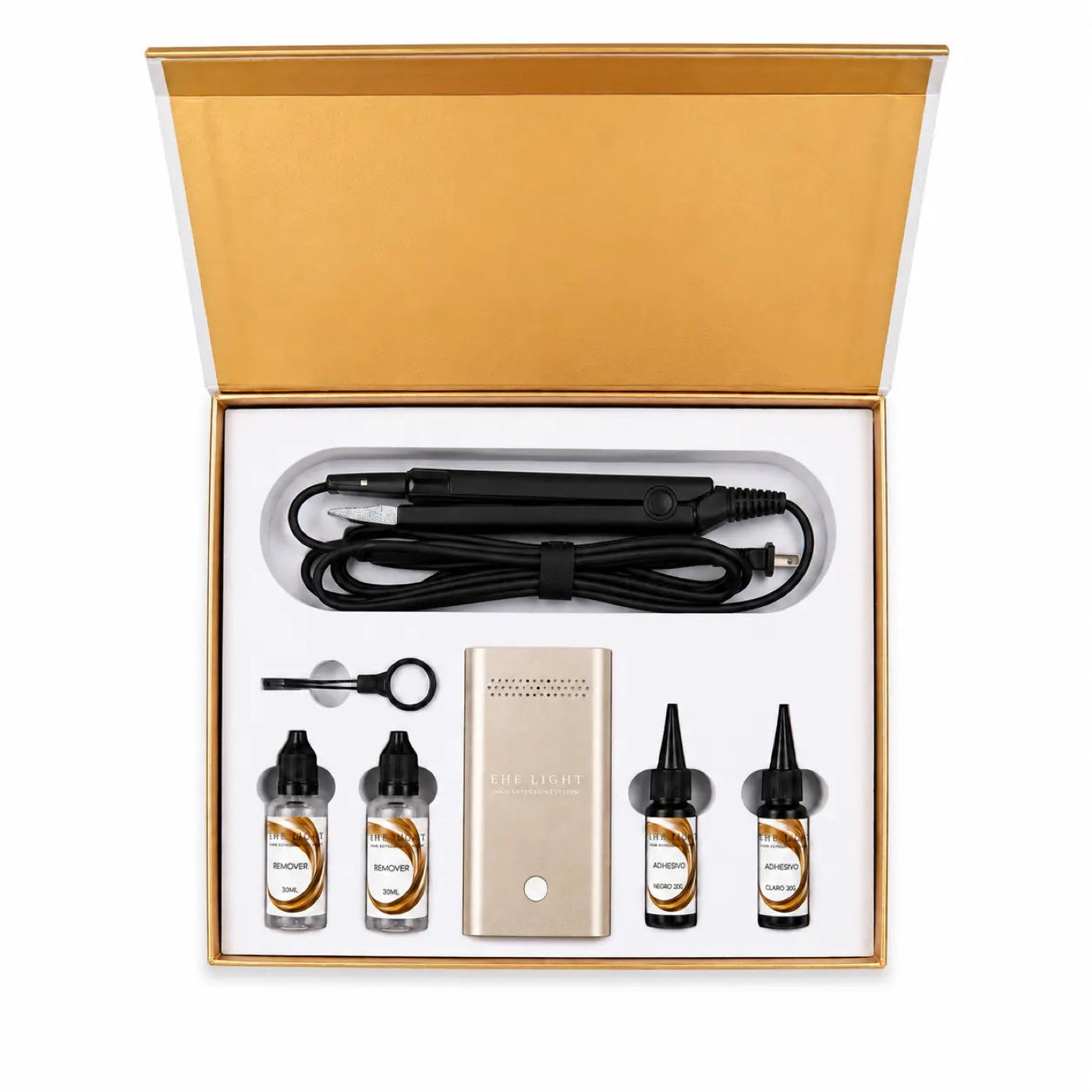
EHE LIGHT™ is a system designed for hair salons: a UV device with CE, RoHS and FCC certification, clear and black adhesive, removal solution, tools, a 14-module Professional Guide (digital manual) and 6 months of VIP support. To see how it compares with keratin, tape-in extensions and micro rings, read UV or keratin extensions: comparing the methods.

Are you a hairdresser who wants to offer UV extensions in your salon?
See the complete professional kitFrequently asked questions about UV light hair extensions
How long does each bond take to cure?
Between 6 and 8 seconds on top and 6 to 8 seconds underneath, with the light within 1 cm of the bond.
Do UV extensions damage the hair?
Application uses no heat, so the hair does not go through the 160 to 200°C of keratin. Applied properly, 1 to 1.5 cm from the scalp and with the right weight, then removed following the protocol, they should not damage your hair.
How long do UV light hair extensions last?
The bond lasts up to 2 months. Maintenance is every 6 to 8 weeks and Remy hair can be reused.
Can you get UV extensions wet?
Yes, the bond is water resistant, but it is best to avoid getting it wet for the first three days. After that, wash your hair two to three times a week: prolonged moisture can soften the bond over time.
How many strands are needed?
As a guide, 80 to 120 bonds to add volume to fine or medium hair, 120 to 200 for a complete change and more than 200 for a lot of length or very thick hair.
Can I apply them myself at home?
We do not recommend it. The system is designed for hair professionals: application, curing and above all removal take technique and equipment.